Koralpenhaus.eu - Hospitality, booking and content management in one System
17.08.2026
Overview
Koralpenhaus.eu is a multilingual web platform for an Alpine accommodation business in Carinthia, Austria.
The project combines the public website with room presentation, availability, pricing, reservations, online deposit payments and customer self-service.
The goal was not to add a booking form to a website.
It was to create one maintainable system in which the public content and the booking process work together — while keeping the experience simple for guests.
Technology stack we used, among others:
PHP • MySQL • JavaScript • Responsive Web • PayPal Integration
The Challenge
Accommodation websites look simple from the outside. The underlying process usually is not.
A guest needs to find a suitable room, select a period, understand the applicable price, check whether enough capacity is available, provide the required information, create a reservation and complete the required payment.
Several rules have to remain consistent throughout that process:
- room capacity
- arrival and departure dates
- existing reservations
- guest categories
- member and non-member pricing
- booking totals
- deposit amounts
- payment state
- reservation validity
The challenge was to handle those rules without transferring their complexity to the guest.
One Continuous Booking Flow
The reservation process is integrated directly into the website.
Guests select a room and their travel dates. The system checks availability for the requested period and reports the remaining capacity.
Guest composition can then be configured within the limits of the selected accommodation.
Pricing is calculated from the booking context rather than presented only as static information.
Before a reservation is submitted, the guest receives a clear summary containing the selected room, dates, number of nights, guest composition and total amount.
The result is a straightforward workflow:
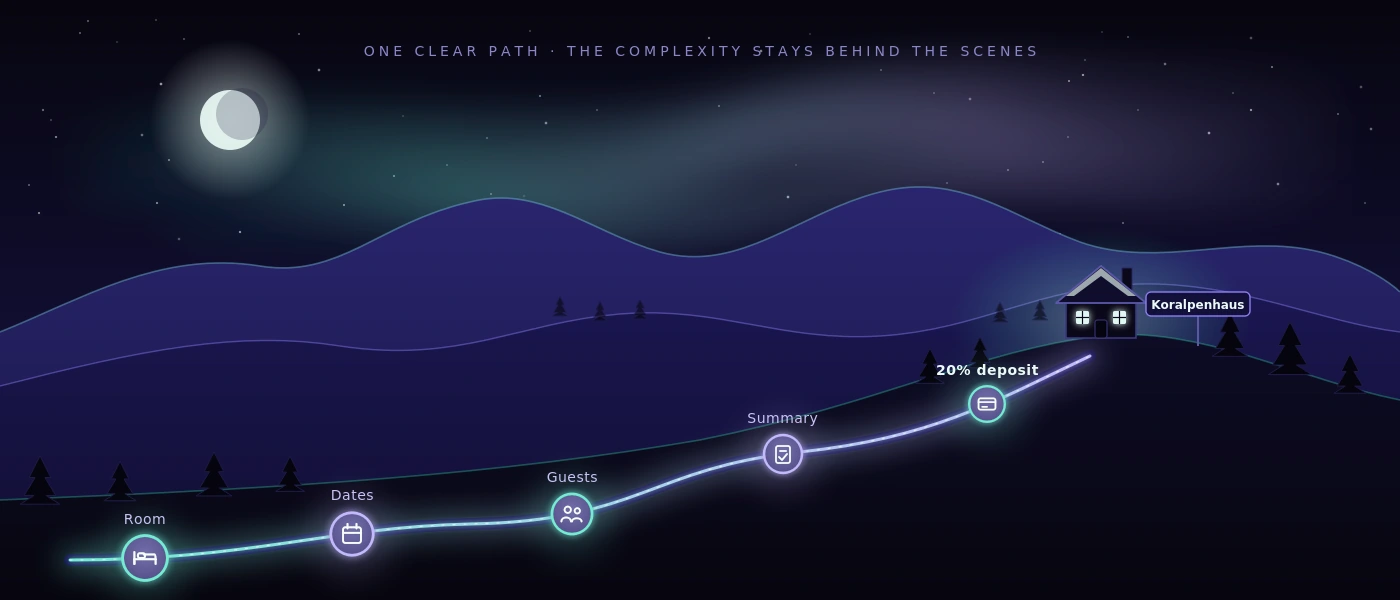
Room → Dates → Availability → Guests → Details → Reservation → Payment
The customer sees a simple process.
The application handles the rules behind it.
Availability and Capacity
Availability is part of the booking logic rather than a separate enquiry.
For the selected period, the application determines whether accommodation is available and how much capacity remains.
Occupancy limits continue to apply when guests are added to the reservation, preventing booking configurations that exceed the capacity of the selected room.
This keeps the availability shown to the customer connected to the reservation being created.
Pricing Rules
Koralpenhaus.eu uses different pricing contexts for members and non-members as well as different guest categories.
These rules are integrated into the booking process.
Instead of requiring guests or staff to calculate prices separately, the application uses the selected booking parameters to produce the corresponding total.
The booking summary therefore becomes the single point at which dates, occupancy and pricing come together before the reservation is submitted.
Reservation Lifecycle
Submitting the booking creates a reservation that can subsequently be retrieved through the My Booking area.
Reservations awaiting payment are clearly marked as Pending payment and include a defined payment period.
The customer can leave the website, return later and retrieve the existing reservation without starting the booking process again.
The reservation retains its room, dates, guest information, price, required deposit and current payment state.
This makes the booking a persistent business object rather than a one-time form submission.
Online Deposit Payment
The payment process is connected directly to the reservation.
Koralpenhaus.eu calculates a 20% deposit from the booking total and presents the amount before payment begins.
Payment is integrated through PayPal, with supported payment options presented within the booking workflow.
The separation is deliberate:
Koralpenhaus.eu remains responsible for the reservation and its business rules, while the payment provider handles the payment transaction.
This keeps payment processing outside the application's own payment-data handling while maintaining a continuous customer experience.
Customer Self-Service
Not every guest needs another user account.
The My Booking area provides a lightweight way for customers to return to an existing reservation and review its current state.
The booking view brings together the information relevant to the customer:
- accommodation
- arrival and departure
- number of nights
- guest composition
- contact information
- booking total
- required deposit
- payment status
Where payment is still outstanding, the customer can continue from the existing reservation.
This reduces unnecessary steps for both guests and staff.
Content and Guest Experience
The booking system is only one part of the platform.
Koralpenhaus.eu also provides the content visitors need before making a decision:
- room presentation
- photo galleries
- video
- location and contact information
- Google reviews
- guestbook
- multilingual information
These elements share the same responsive interface as the reservation workflow.
The intention is to avoid the common split between a presentation website and an unrelated external booking experience.
Guests remain within one consistent digital environment from discovery to reservation.
Moderated User Content
The guestbook allows visitors to submit their own entries without publishing submitted content immediately.
This provides a controlled workflow for user-generated content and allows the public guestbook to remain useful without treating every submission as trusted content.
Public contribution and editorial control remain separate concerns.
Administration
Public functionality and administration are separated.
Koralpenhaus.eu provides a dedicated authenticated administration entry point for internal functionality, while the public interface remains focused on guests.
This separation allows operational functionality to remain behind authentication without adding administrative complexity to the customer-facing application.
Multilingual by Design
Koralpenhaus.eu serves both regional and international guests.
Multilingual support is therefore part of the application rather than an additional landing page.
Navigation, accommodation information and substantial parts of the booking experience are presented within the selected language context.
The same underlying application and business processes can therefore serve different audiences without maintaining separate websites.
Mobile Matters
A booking platform has to work where customers actually use it.
The Koralpenhaus.eu interface was designed to keep room selection, calendars, availability, guest configuration, booking summaries and payment actions usable on smaller screens.
Complexity is reduced through progressive steps rather than displaying the complete reservation model at once.
The responsive interface remains consistent across the presentation and transactional parts of the application.
Engineering Principle
The project follows a simple principle:
Business complexity should be handled by the system, not by the user.
A guest should not need to understand reservation states, availability calculations, pricing structures or payment workflows.
They should be able to:
Choose a room.
Select dates.
Enter the guests.
Book.
Pay the deposit.
Everything else belongs behind that interaction.
Result
Koralpenhaus.eu evolved into more than a presentation website.
It combines content, hospitality-specific business rules and transactional workflows within one custom web application.
For guests, the result is a clear path from discovering the accommodation to managing a reservation.
For the business, the same platform provides the structured foundation required to connect accommodation, availability, pricing, reservations, payments and content.
No unnecessary technology was added simply for the sake of using it.
The stack remains conventional and maintainable:
PHP • MySQL • JavaScript
The complexity is in the business process.
The software exists to make that complexity manageable.