
Web Development with Current Frameworks: What Businesses Really Gain
If a goods receipt still shuttles between a paper form, a phone call, and three Excel files, a modern frontend alone won't solve the problem. Web development with current frameworks makes sense when it visibly simplifies workflows: employees see the next step, data is captured only once, and the application remains understandably maintainable even after the first go-live.
For small and mid-sized companies, the framework question is therefore not a matter of faith. What matters isn't whether an interface carries especially many technical buzzwords. What matters is whether warehouse movements, orders, inspections, or approvals get through the working day reliably - even under time pressure, shift changes, and fluctuating network connections.
Frameworks are a means, not a project goal
A framework provides a proven structure for recurring tasks: routing, forms, permission management, data access, tests, and the rendering of interfaces. That doesn't automatically reduce every risk. But it prevents a project from having to reinvent basic functions again and again.
In a custom web application, a modern JavaScript framework can, for example, sensibly represent interactive screens: a picking list that continuously updates items, route planning with clear status changes, or an inspection log that assigns photos and comments directly to a transaction. In the backend, established PHP frameworks provide traceable rules, clearly separated responsibilities, and consistent interfaces to the database.
This is especially relevant when an initially small solution turns into an operating system used daily for a process. A form for delivery notices can start out manageable. As soon as it updates stock, outputs labels, takes roles into account, and communicates with a shipping provider, it needs a clean technical foundation. Frameworks help avoid renegotiating that foundation with every extension.
What current web frameworks concretely do better
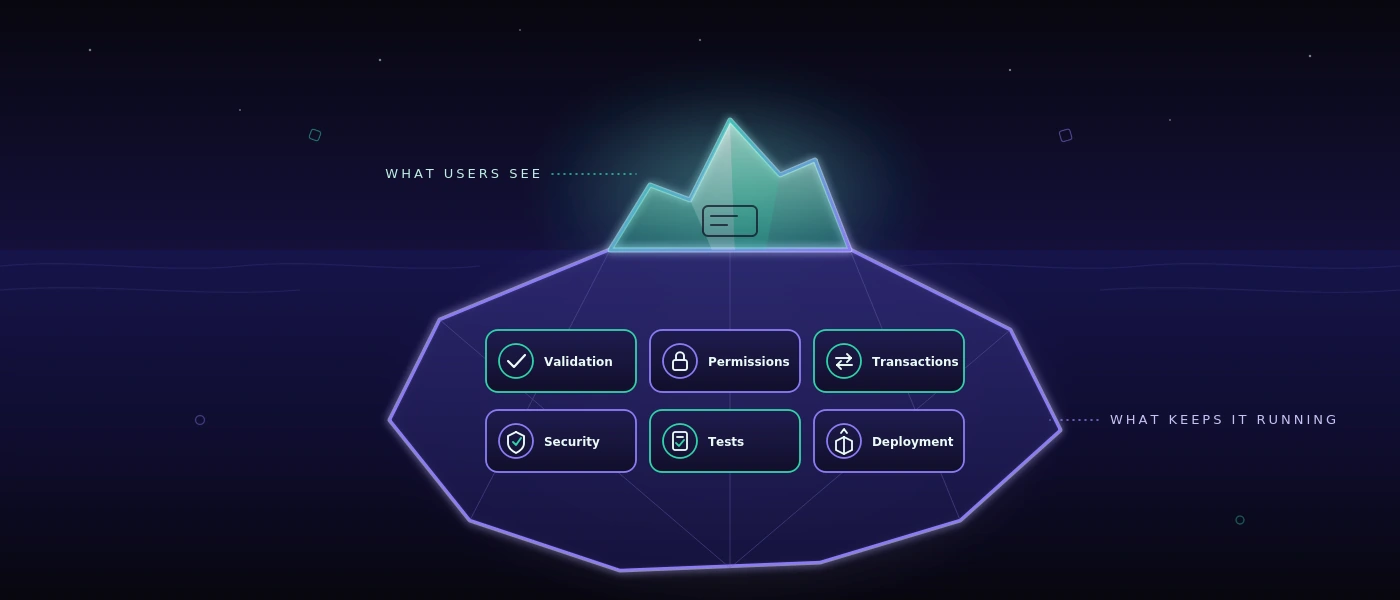
The value of modern frameworks rarely lies in spectacular effects. It shows in the invisible parts of an application. Forms can check input immediately, without faulty data only becoming apparent after submission. Permissions can be defined centrally, so a driver sees different information than dispatch. Changes to an order are stored traceably, instead of silently overwriting a spreadsheet cell.
On the server side, a current environment with PHP 8.4 and MySQL 8 creates a resilient foundation for business-critical logic. Database transactions prevent, for example, a stock level from being reduced while the associated booking fails. Unique keys and validation rules avoid duplicates. Background processes can generate documents or call interfaces without the person at the screen having to wait.
Security isn't a retrofit function either. A contemporary framework supports secure password storage, protection against typical input attacks, traceable sessions, and defined account-lockout flows. Even so, implementation remains a project task: permissions have to be modeled correctly from a business perspective, and sensitive functions need additional checks. A framework provides guardrails, but no knowledge of who in the business may grant which approval.
Deciding on web development with current frameworks properly
The best technology doesn't come from a list of popular tools, but from actual use. An internal application for ten people has different requirements than a customer portal with several thousand simultaneous accesses. A warehouse terminal with a scanner needs different operating logic than a management report on the desktop.
That's why a sensible decision begins with concrete questions: which processes measurably cost time today? Which data is transferred multiple times? Where do errors arise because information only becomes visible too late? Which existing spreadsheet works well enough and should initially stay? That last point in particular protects against expensive digitalization projects without operational benefit.
For many custom business applications, a server-rendered system with targeted interactive components is the most sensible choice. It loads quickly, is manageable to operate, and avoids unnecessary complexity. A fully decoupled single-page application, by contrast, can be appropriate when the interface handles very many dynamic states, has to work offline, or is later supposed to provide the same functions to a mobile app.
Both can be right from a business perspective. The question isn't: which framework is the most modern? It is: which architecture can still be safely extended, tested, and understood by your own team in two years?
When less technology is the better technology
Not every process needs a complex frontend. A lean form for internal orders can be faster, more stable, and cheaper than an elaborately animated interface. If an Excel file is maintained only once a month and causes no errors, it may well still be the right tool.
Complexity only pays off when it removes real friction. That can be the case when orders are retyped several times, delivery status has to be queried by phone, or nobody is sure which version of a document applies. Then a central application creates clear benefit: one data state, clear responsibilities, and fewer follow-up questions.
Maintainability begins before the first line of code
Frameworks are often seen as accelerators. That's only true if the business rules are sufficiently clear beforehand. A developer can build a state machine cleanly from a technical standpoint. But whether the status sequence really fits the process is decided during requirements capture: when does goods count as received? Who may close a deviation? What happens with a partial delivery?
These decisions belong in documentation, as do interfaces, data fields, and exceptions. That doesn't make projects slower. It reduces later discussions, because it becomes visible which rule was deliberately implemented and which assumption is still open.
Maintainability also shows in small disciplines. Database changes must be versioned. Deployment steps must be documented. Error messages should be usable for operations and development without revealing confidential details. Automated tests check central workflows with every change, such as creating an order, calculating a quantity, or producing a delivery note.
For critical applications, a single test type isn't enough. Unit tests secure individual rules, integration tests check the interplay with the database and interfaces, and end-to-end tests replay real operating paths in the browser. For web and Windows applications, a self-hosted test environment can additionally deliver screenshots, execution logs, and understandable assessments, without unnecessarily handing internal test data to external cloud services.
Performance comes from architecture and data model
A modern interface doesn't become fast just because it uses a current framework. Slow database queries, oversized images, or unclear interfaces stay slow, regardless of the frontend. Especially with lists of orders, items, or movement data, the data model decides the perceived speed.
Clean indexes in MySQL 8, paginated queries, and deliberately loaded data are often more effective than later optimization at the interface. A clear caching concept is just as important. Master data may under some circumstances be cached, while current stock levels or approval status should not be cached blindly. There's no blanket rule here, because the business meaning of the data determines how current it has to be.
Responsive design is also part of technical planning. On the office screen, a wide table can make sense. On a handheld scanner or tablet in the warehouse, the same information needs large touch targets, short paths, and a presentation that remains usable even with gloves or in poor light. Pure fluidity meets ultimate performance in this context doesn't mean as much motion as possible on the screen. It means the application works without friction on the device actually used in the process.
The sensible path from idea to operation
A robust web project starts with a limited, verifiable core. Instead of automating every conceivable exception up front, a process is chosen that occurs often and noticeably causes effort. After the first deployment, real data and feedback show which extension really has priority next.
The technical handover shouldn't only happen at the end. Responsibilities for hosting, backups, monitoring, updates, and access rights have to be clarified early. A system is only as reliable as its operation. Anyone who needs an application daily for shipping or order processing needs defined recovery paths and a clear answer to what happens in case of a disruption.
softify.pro therefore relies on maintainable technologies, documented delivery, and direct technical responsibility instead of short-lived framework fads. That's no magic shortcut. It creates the precondition for an application to keep working after launch, to be developed further, and not to become the next fragile special case.
At best, the right web application doesn't feel like a new IT project. It feels like a workflow that finally works without detours - with enough technical substance to take the next change in operations calmly in stride.