
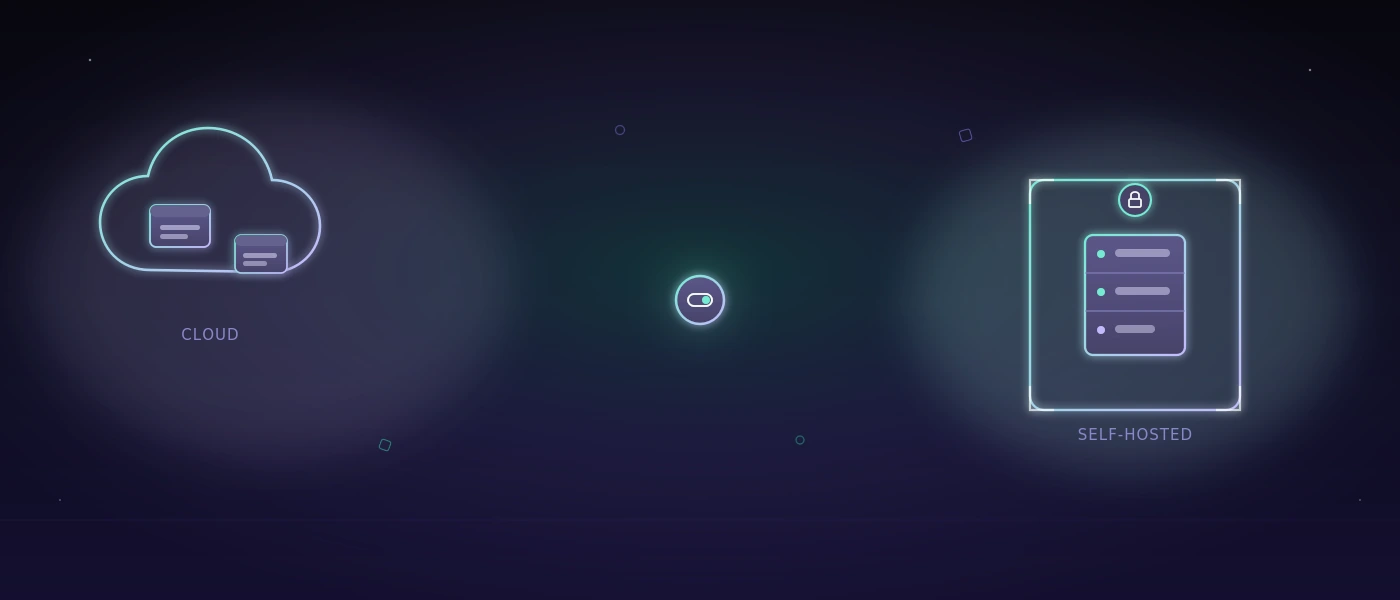
Self-Hosted Testing vs Cloud
A failed regression test is rarely just a red entry in a dashboard. It can mean that a shipping screen in the warehouse generates wrong labels, a customer portal stops accepting orders, or a Windows application crashes during a shift handover. The question of self hosted testing vs cloud isn't therefore about infrastructure as an end in itself. It's about which data a testing process touches, who controls it, and how reliably it runs under real operating conditions.
Cloud-based testing platforms can be up and running quickly. For many teams that's sensible, especially when testing a public web application and needing additional execution capacity on short notice. Self-hosted testing environments, by contrast, require a deliberate technical setup. But they hand control over test data, network paths, access rights, and operation back to the company. The right choice doesn't depend on a general principle, but on the application, the risk, and the operational capability at hand.
Self Hosted Testing vs Cloud: What It's Really About
The debate is often reduced too heavily to upfront cost. A cloud solution looks cheaper because no servers need to be procured and no environment needs to be set up. A dedicated test server looks more elaborate at first glance, because the operating system, updates, access control, monitoring, and backups all need planning.
That calculation falls short. What matters are the ongoing costs of a testing strategy: waiting times before releases, debugging after incomplete test runs, coordination with privacy and information security, and the consequences of a faulty deployment. If a team regularly examines sensitive line-of-business applications, the additional organizational overhead of external services can outweigh operating a clearly bounded environment of its own.
"Cloud" is also not a uniform model. Some providers merely store test logs, others process screenshots, video recordings, credentials, DOM content, or network traffic. With AI-assisted testing, image and text data may additionally reach external models or subcontractors for evaluation. Whoever only looks at a data center's location often misses the more important question: which data actually leaves the company's own control zone, and what contractual and deletion rules apply to it?
When cloud testing is the sensible choice
Cloud testing isn't inherently a security problem, and self-hosting isn't automatically the better architecture. For a new, publicly reachable web shop or a marketing platform, a cloud environment can be very fitting. The team can quickly cover browser and device variants without maintaining its own execution machines. With fluctuating test load, elastic scaling is also a real advantage.
Small development teams with few, clearly anonymized test data sets also often benefit from a managed service. They shouldn't invest their time in operating a platform when the actual bottleneck lies in missing test cases, unclear acceptance criteria, or unstable test data. A dedicated server doesn't solve those problems.
The cloud fits especially well when the application needs no internal network access, no personal or business-critical data appears in the test flows, and short lead time matters more than deep infrastructure control. The prerequisite is careful configuration: separate test accounts, no real customer data, scoped tokens, traceable retention periods, and a clear rights concept.
When self-hosted testing becomes more sensible
Things look different for applications that are only reachable within the company network or that map core operational processes. Warehouse or production software often processes item movements, delivery addresses, stock, serial numbers, and pricing logic. A test run can generate screenshots of order screens, download documents, or log in with user roles. Such data shouldn't be scattered unnoticed across several external systems.
Self-hosted testing allows the test execution to be placed close to the application. The test server can run in the same network segment or in a controlled DMZ. Firewall rules are set deliberately, internal applications don't need to be opened up to an external service, and logs remain under the company's own administration. This is often especially relevant for Windows desktop applications, since these are rarely designed for external testing platforms.
For regulated industries, larger customer requirements, or internal security policies, this architecture is often easier to audit. That doesn't mean every audit is automatically passed. A dedicated server also needs patch management, encryption, role-based rights, backups, and documented operating procedures. The difference is that the company makes these decisions itself and can demonstrate them.
At softify.pro, COCO is therefore designed as a dedicated, self-hosted AI server: test runs for web and Windows applications execute locally, evidence gets recorded, and results are evaluated in plain language. That doesn't replace domain-expert sign-off. But it does ensure that test traffic, screenshots, and evaluations can stay where the company retains data sovereignty.
Comparing costs correctly: operations against friction
A sensible comparison covers more than license price versus hardware price. In the cloud, recurring fees arise per user, test minute, parallel execution, or AI consumption. These costs are predictable at first, but can rise significantly as test coverage grows. On top of that come possible expenses for enterprise contracts, data processing agreements, and security reviews.
With self-hosting, investments arise for infrastructure and setup. That can include virtual machines, storage, network access, monitoring, and the time of a technically responsible team. These costs remain even when few tests are running. For a project with rare releases, that's a good argument against an oversized in-house solution.
With regular regression testing, the picture shifts. If the same business-critical workflows need checking every week, predictable internal capacity is often more economical than variable platform costs and manual approval loops. The approach becomes especially valuable when test cases are used for years and evolve alongside the line-of-business application. Maintainability then matters more than a fast but hard-to-control start.
Quality doesn't depend on the hosting model
A common misconception says cloud tests are automatically more modern, self-hosted tests automatically more stable. Neither is true. Test quality comes from sensible scenarios, resilient test data, stable identifiers in the interface, and clear expectations for the result.
A test shouldn't just check whether a button is clickable. For order processing, it might, for example, create an order, check an available quantity, generate a delivery note, and ensure that the correct role is allowed to approve the transaction. For a desktop program, it can verify the import of a file, error handling, and the output of a document. Only such end-to-end flows show whether a change has damaged the real process.
AI can help here by detecting interface changes, documenting steps in plain language, and prioritizing anomalies. But it shouldn't become a black box. Teams need screenshots or other evidence, traceable test steps, and defined thresholds for when a result counts as passed, uncertain, or failed. Especially for visual checks, a confidence threshold makes sense, so small, expected layout deviations don't block every release.
The operational questions before the decision
Before a team commits, it should concretely trace the path of a test run. Where does the test execute? Which systems does it log into? What data does it see? Where are screenshots, logs, and reports stored? Who's allowed to read, delete, or export results? These questions are more practical than a blanket decision for or against the cloud.
Equally important is responsibility after go-live. Who updates browsers and test agents? Who responds when a certificate expires? How are credentials rotated? And how is it ensured that a test doesn't accidentally trigger a real shipping booking or customer notification? Good test automation needs separate environments and protective mechanisms, not just good scripts.
A hybrid model can make sense. Public interfaces and broadly distributed browser checks run in the cloud, while internal line-of-business processes stay on a dedicated test server. That reduces operational overhead without handing sensitive workflows over wholesale. The prerequisite is a clear boundary between the two areas, not a confusing mixed setup.
The best decision is the one that fits the actual risk and the company's own operational reality. If a spreadsheet still carries a process reliably, it doesn't need to become a large system. But if test data and internal applications belong to the business core instead, control isn't a luxury - it's a factual requirement for reliable software.